Disclaimer: The opinions expressed in this article are my own and do not represent the views of Google. This content is based solely on publicly available information.This content is for educational and entertainment purposes only. The author is not a financial advisor, and the content within does not constitute financial advice. All investment strategies and financial decisions involve risk. Readers should conduct their own research or consult a certified financial professional before making any financial decisions.
If you ever put a chart of Germany’s DAX 40 next to the S&P 500, you might be surprised to see how closely they seem to move together, even though the stories behind them are so different. While the Eurozone has been stuck in a rut, Germany has been wrestling with energy problems, and its factories haven’t really grown since 2018, the DAX still seems to follow the S&P 500 almost stride for stride over the long run. That’s the kind of thing that makes you want to pause and dig a little deeper, especially if you like to figure out how things work. After all, if one market is driven by big American tech companies and the other by German manufacturers, it doesn’t really make sense for their charts to look so similar. The real reason for this isn’t some hidden market magic, but rather a quirk in how the numbers are put together: the DAX and the S&P 500 are often shown using two different types of indexes, and that mix-up can make two very different things look almost the same.
The Mechanics of the Performance Index
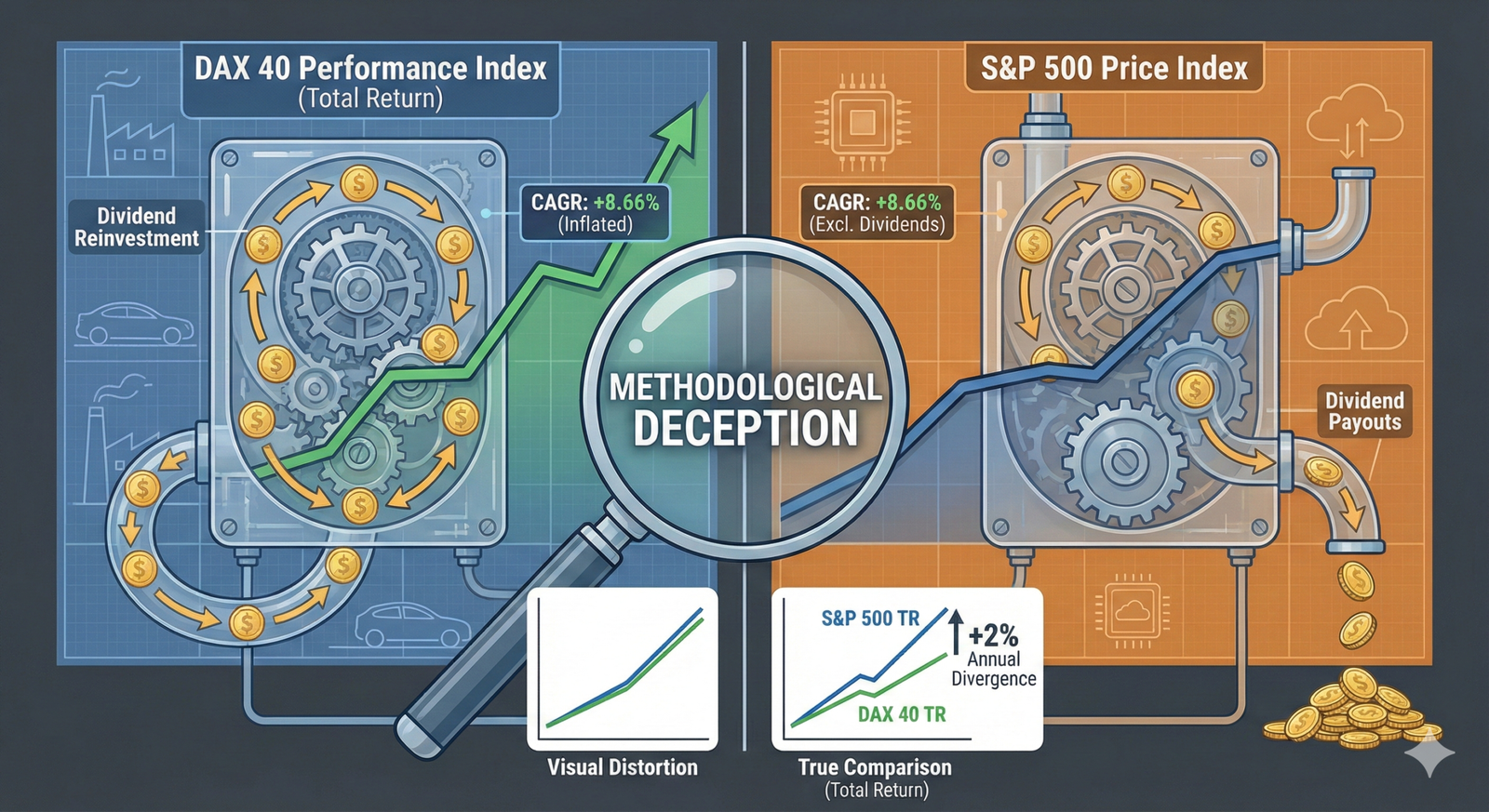
If we want to figure out why these comparisons can be so misleading, it helps to look at how the indices are actually built. The S&P 500, which is the version you usually see on CNBC or Google Finance, is what’s called a Price Index. That means when a company like Apple pays out a dividend, the cash just leaves the index calculation, so the stock price drops by the amount of the payout and the index only recovers if the market pushes it back up. The DAX 40 works differently because it’s a Performance Index, or what’s sometimes called a Total Return index. Here, every dividend from companies like Siemens, Allianz, or BASF is automatically reinvested into the index, so the value keeps compounding over time. This means the DAX 40 keeps all those dividends inside, while the S&P 500 lets them flow out to shareholders. So, when you compare the two, it’s a bit like having one runner who gets to drink water during the race and another who has to pour their water out at every checkpoint. It’s not really a fair race.
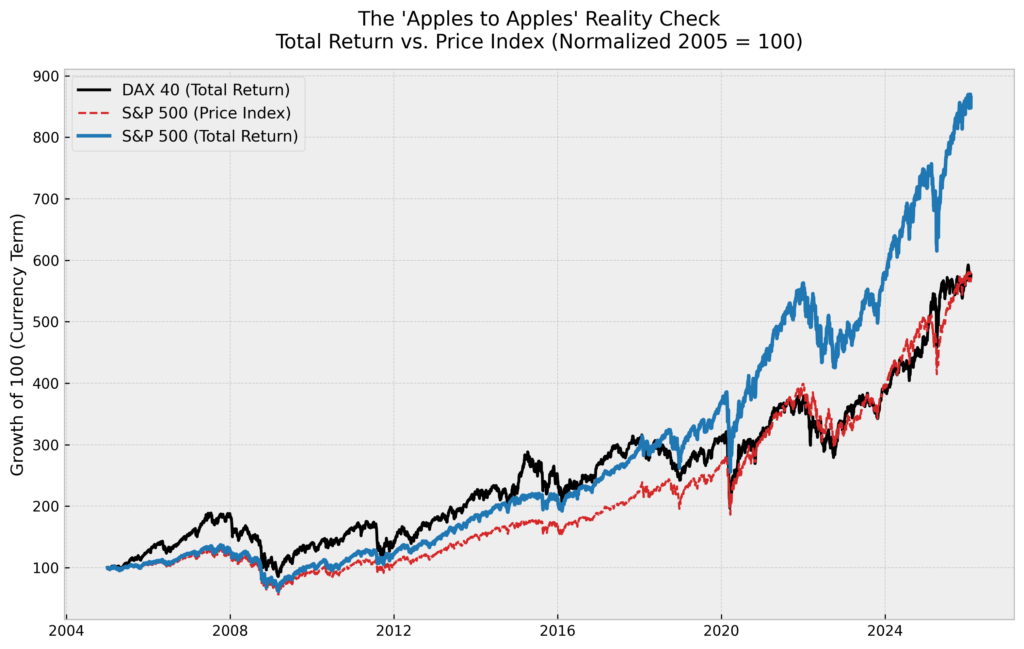
If you look at the numbers over the last twenty years, you can really see how much this difference in calculation matters. When we ran the numbers, comparing the usual DAX 40 (which includes all the reinvested dividends) to the standard S&P 500 (which doesn’t), both showed a compound annual growth rate of 8.66% and almost the same level of ups and downs. At first glance, it looks like German industry is just as good at growing wealth as the big tech companies in the US. That’s the story that keeps a lot of money flowing into European ETFs. But if we make the comparison fair—by looking at both indices with dividends reinvested—the picture changes completely. The S&P 500 Total Return version comes out way ahead, with a 10.77% annual growth rate and a better risk-adjusted return. That extra 2% each year might not sound huge, but over twenty years, it adds up to a much bigger difference than you might expect, and it’s easy to miss if you’re just looking at the standard charts.
Under the Hood: A Legacy Engine
If we take a closer look at the companies that make up the DAX, it becomes pretty clear why the index has been lagging behind. While the S&P 500 has shifted over time from being mostly about factories and heavy industry to focusing on technology companies, the DAX is still mostly made up of businesses that build things in the real world, much like it did decades ago. SAP is really the only big tech player here, making up about 17% of the index, but after that, you mostly find companies that make chemicals, cars, or handle insurance. Big names like Siemens, Allianz, and Airbus each have a lot of weight in the index, but these are businesses that need to spend a lot of money just to keep running, and they usually don’t get the same high returns as American software companies. If you look at the chart below, you’ll see that the ‘Technology’ part is basically just SAP, while almost everything else is tied to manufacturing, which has been hit hard lately by expensive energy and tough competition from China.
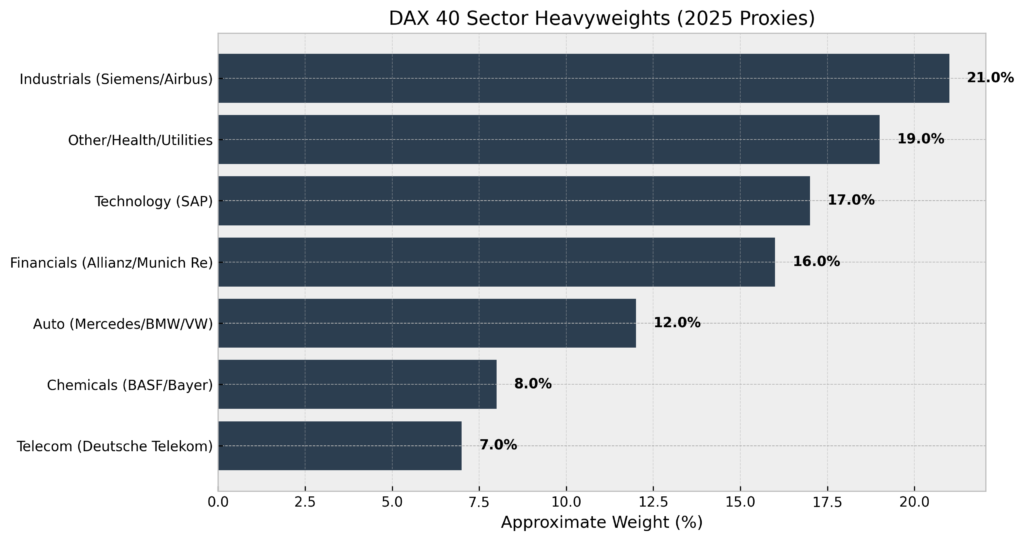
If you’re looking to diversify by investing in the DAX 40, it might seem at first like you’re getting a nice cross-section of the German economy, but what you’re really doing is putting most of your eggs in the baskets of a handful of big industrial companies and just one major software business, so it’s not quite the broad exposure you might expect. When you look at the numbers, you can see that the DAX sometimes moves differently from the S&P 500, especially when currencies are bouncing around, but over the long run, even after you count all the dividends, it just doesn’t keep up with the US market. People often talk about the DAX as if it’s a bargain or a classic ‘value’ investment, but if you dig a little deeper, it starts to look more like a value trap, since the way the index is put together tends to hide the fact that many of its companies haven’t really been growing. So if you’re excited about German engineering and want to invest in that, it probably makes more sense to pick out the companies that are still pushing the envelope, because buying the whole index mostly means signing up for a system that makes slow progress look like stability.
References
[1] Deutsche Boerse Group. “DAX Index Methodology Guide.”
[2] S&P Dow Jones Indices. “S&P 500 Methodology.”
[3] Yahoo Finance. “Historical Data for ^GDAXI and ^SP500TR.”

Leave a Reply