Disclaimer: The opinions expressed in this article are my own and do not represent the views of Google. This content is based solely on publicly available information. This content is for educational and entertainment purposes only. The author is not a financial advisor, and the content within does not constitute financial advice. All investment strategies and financial decisions involve risk. Readers should conduct their own research or consult a certified financial professional before making any financial decisions.
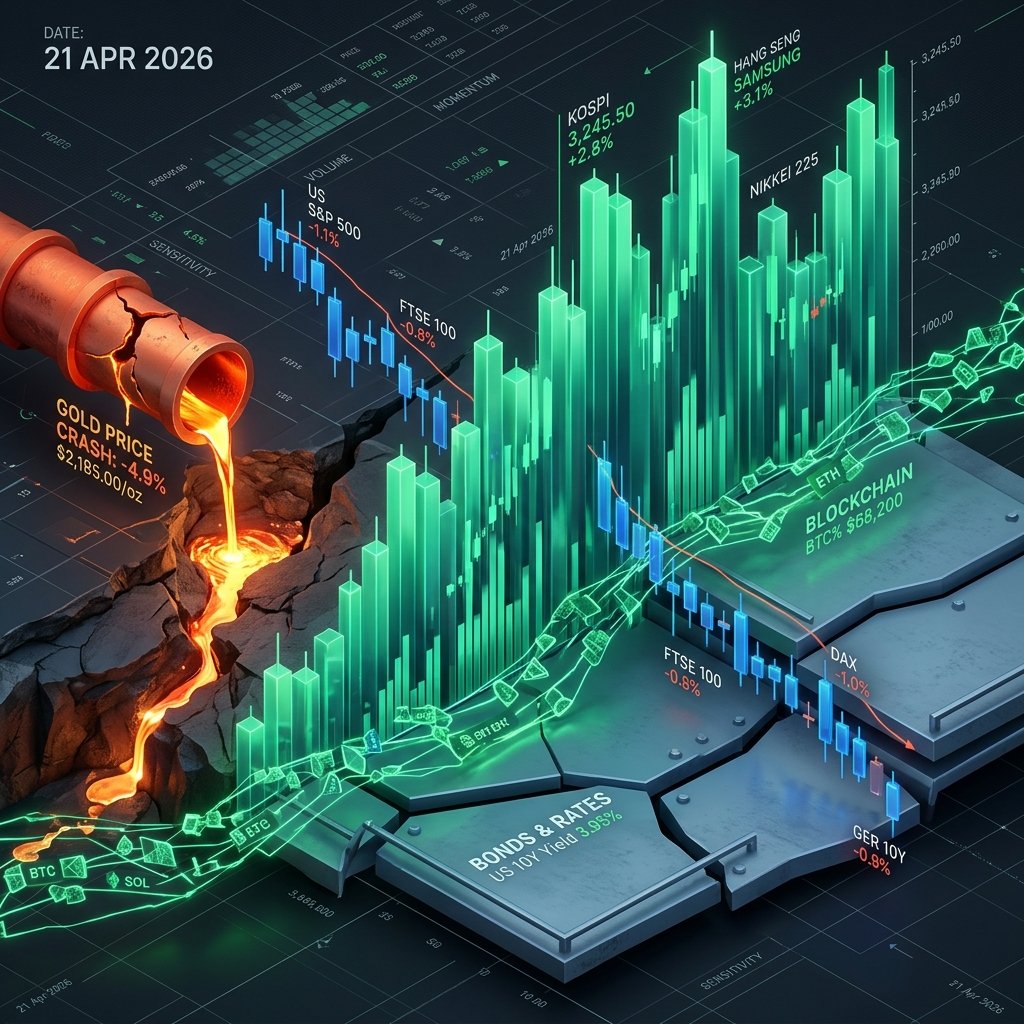
Today, April 21, 2026, we saw something pretty striking in the global markets: while investors in North America and Europe were clearly feeling nervous and pulling back because of all the geopolitical tension, the mood in Asia was almost the opposite, with tech stocks—especially those tied to semiconductors—taking off in a way that seemed to ignore all the usual market worries, at least for a little while.
There were a few big shifts in the markets today, and most of them seemed to come down to two things: how well semiconductor companies are doing and the ongoing uncertainty around global politics.
- The KOSPI index jumped 2.72% after Samsung and SK Hynix shared some really strong first-quarter forecasts, which is a pretty clear sign that the demand for AI hardware is picking up speed.
- Meanwhile, stocks in the U.S. and Europe slipped because the ceasefire talks between the U.S. and Iran hit a rough patch, which just added to the general sense of uncertainty.
- Gold actually fell 1.42% to $4,738.50, which is a bit surprising since people usually buy gold when things feel risky, but this time the stronger U.S. dollar seemed to change the usual pattern.
- Oil prices stayed high, above $90, mostly because there are still worries about supply and ongoing instability in the Middle East.
If you look at the numbers across different markets, you can really see how different regions are moving in their own directions right now. The KOSPI jumped 2.72% and Taiwan’s TSEC was up 1.75%, which is a big contrast to the S&P 500 dropping by 0.63%. That gap—over three percentage points—shows just how much South Korea and the U.S. are moving apart, and a lot of it comes down to the boom in semiconductors. While investors in the West are worried about political delays and uncertainty, folks in the East seem to be leaning into the ups and downs of the hardware cycle.
| Index / Asset | Price | 1Day Change | YTD Change |
|---|---|---|---|
| S&P 500 (SPX) | 7,064.01 | -0.63% | +3.19% |
| NASDAQ Composite (IXIC) | 24,259.96 | -0.59% | +4.38% |
| STOXX Europe 600 | 616.03 | -0.87% | +3.92% |
| DAX Performance-Index (Germany) | 24,270.87 | -0.60% | -0.90% |
| Nikkei 225 (N225) | 59,349.17 | +0.89% | +17.90% |
| Hang Seng Index (HSI) | 26,487.48 | +0.48% | +3.34% |
| US 10-Year Treasury Yield | 4.26 | +0.00 pts | +0.08 pts |
| VIX (CBOE Volatility Index) | 19.50 | +0.63 pts | +4.55 pts |
| Crude Oil (WTI) | 90.22 | +0.68% | +57.12% |
| Gold | 4,738.50 | -1.42% | +9.55% |
| Bitcoin | 75,563.00 | -0.41% | -13.65% |
| Ethereum | 2,312.20 | -0.13% | -22.07% |
But while the numbers give us a snapshot of what’s happening right now, it’s worth digging a little deeper to figure out what’s really driving these moves under the surface.
North America: Geopolitical Latency and Order Book Fragility
U.S. stocks, especially the S&P 500 and NASDAQ, had a tough day, slowly losing ground as the back-and-forth between Tehran and Washington picked up. There was a bit of hope for a rally early on, but that faded quickly when news broke that a key diplomatic trip to Pakistan was canceled, which made the whole situation with the U.S. and Iran feel even more uncertain. When it looks less likely that things will calm down, investors tend to play it safe and hold onto cash instead of taking risks.
The NASDAQ slipping by 0.59% really stood out to me, especially since you might expect U.S. tech stocks to ride the wave from all the excitement around Asian chipmakers, but that just didn’t happen today. It feels like investors are more worried about the risks that come with higher interest rates than they are excited about companies making more money, and with the 10-Year Treasury Yield stuck at 4.26%, there’s not much room for comfort. The market is getting squeezed from both sides—on one hand, there’s all the uncertainty from global politics, and on the other, interest rates just won’t budge. When news broke about the canceled diplomatic trip, it added another layer of unpredictability, so a lot of the folks who run the numbers started hedging in case things get even bumpier. The VIX climbing to 19.50 is just one way you can see how much more jumpy the whole system feels right now.
Europe and Asia: The Hardware Signal vs. The Geopolitical Noise
European stocks also took a hit, with the STOXX 600 down 0.87%, and a lot of that comes back to worries about energy. Since Europe relies so much on oil and gas from the Middle East, any trouble there tends to show up quickly in European markets. The DAX dropping by 0.60% is a sign that manufacturers are starting to get uneasy about oil prices staying above $90, because when energy gets expensive, it makes everything from running factories to buying everyday goods a little harder, and that can set off a chain reaction where people spend less and businesses start to feel the pinch.
If you dig a bit deeper, it looks like Asia’s big rally isn’t only about selling more chips. Sure, companies like Samsung are making headlines with strong earnings, but there’s also a lot of money coming in from investors who just want a calmer place to put their cash, far from all the political drama happening in the West. The KOSPI reaching a record high is as much about Asia being seen as a safe spot as it is about tech sales, and this shift in where the money is flowing shows that a lot of big investors are trying to steer clear of the risks that come with Western politics.
Commodities and Crypto: The Liquidity Squeeze
One of the things that really caught my eye today was gold dropping by 1.42%. Usually, when the world feels uncertain, people rush to buy gold, but this time around, the U.S. dollar got stronger and made gold less attractive to hold. Since gold doesn’t pay any interest, a stronger dollar means it costs more to keep your money in gold, so a lot of investors decided to sell. It’s one of those odd moments where the same worries that would normally send gold higher are also making the dollar stronger, so gold actually goes down instead.
Crypto followed a similar path, though not quite as sharply. Bitcoin dipped by 0.41% and Ethereum was down 0.13%. Even with some big companies still putting money into crypto, things feel pretty tight at the moment. Right now, crypto is behaving like a riskier version of the regular stock market, and unless something big changes—like a move from central banks or a major political breakthrough—these coins will probably just keep bouncing around, stuck between new interest from big investors and all the big challenges out there.
Systemic Outlook
If you zoom out and look at everything together, it feels like the markets today are a bit like a machine with some gears spinning fast and others barely moving. Asia’s tech sector is charging ahead, while the West is kind of stuck on pause, waiting to see what happens with all the political talks. This kind of split can’t go on forever, and right now, you can really see investors moving their money around as they try to figure out what’s next. The big question is whether the tech rally in Asia means the whole world is about to turn a corner, or if it’s just a bright spot in a world that’s drifting further apart.

Leave a Reply