Disclaimer: The opinions expressed in this article are my own and do not represent the views of Google. This content is based solely on publicly available information.This content is for educational and entertainment purposes only. The author is not a financial advisor, and the content within does not constitute financial advice. All investment strategies and financial decisions involve risk. Readers should conduct their own research or consult a certified financial professional before making any financial decisions.
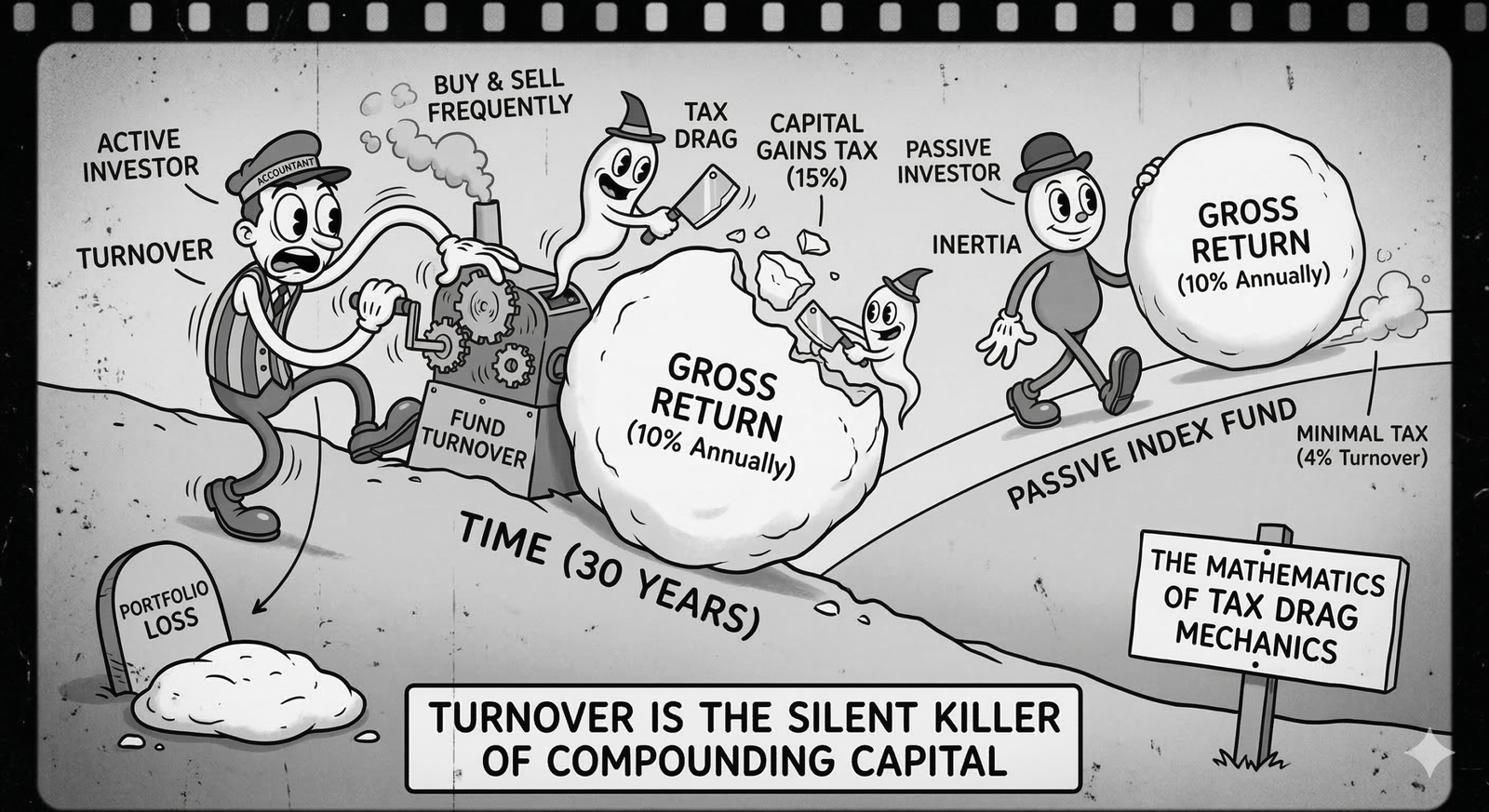
A lot of the usual financial advice makes picking a fund that beats the market sound like a puzzle you can solve if you just crunch enough numbers, so people end up spending hours comparing fees, digging through manager histories, and tweaking their portfolios to squeeze out a tiny bit more return. But in all that effort, it’s easy to overlook the one thing that quietly does the most damage to your long-term growth: turnover, which is like a slow leak that drains away the power of compounding.
Every time a fund manager is busy buying and selling, they’re creating taxable events that quietly pull money out of your account and hand it over to the government. This isn’t just some abstract idea; it’s a real, ongoing cost that chips away at your returns year after year. What’s funny is that the financial industry doesn’t talk much about these taxes, probably because they don’t make money when you just sit tight. I always find it a bit ironic that engineers will spend days shaving a couple milliseconds off a system, but then overlook how much wealth they lose to taxes just because their investments aren’t set up in a tax-friendly way. To really see how much this matters, we need to actually run the numbers and see how much gets lost along the way.
The mathematics of tax drag mechanics
Let’s walk through a simple scenario together: picture two people, each starting with $100,000, and both somehow stumble onto investment strategies that give them a steady 10% return every year for 30 years before taxes. The only thing that sets them apart is how often they actually cash in on those gains.
One of these investors goes with an actively managed fund, which basically means the manager is buying and selling stocks all the time. According to Morningstar, these funds often swap out half their holdings every year, and sometimes even more. Each time the manager sells something for a profit, that triggers a capital gains tax—let’s say 15% for long-term gains, just to keep things simple. So, year after year, this investor has to hand over a slice of their profits to the government, almost like paying a small toll every time they cross a bridge.
The other investor picks a plain old index fund, which mostly just sits tight and only makes a few changes each year—usually about 4% of the portfolio gets shuffled around because of things like rebalancing or companies dropping out. That means almost all of the growth just keeps building on itself, untouched, since the government can’t tax gains that haven’t actually been cashed in yet.
If we try to put some numbers to this, the idea is pretty straightforward: each year, your investment grows by that 10%, but if you’re selling a chunk of it (because of turnover), you have to pay taxes on the gains from those sales:
So, after paying the tax, you have a little less left to keep growing for the next year:
Where would be .
It might not seem like a big deal at first—just a small bite taken out each year—but over a few decades, those little bites really add up and can seriously shrink what you end up with.
Quantifying the turnover cost comparison over three decades
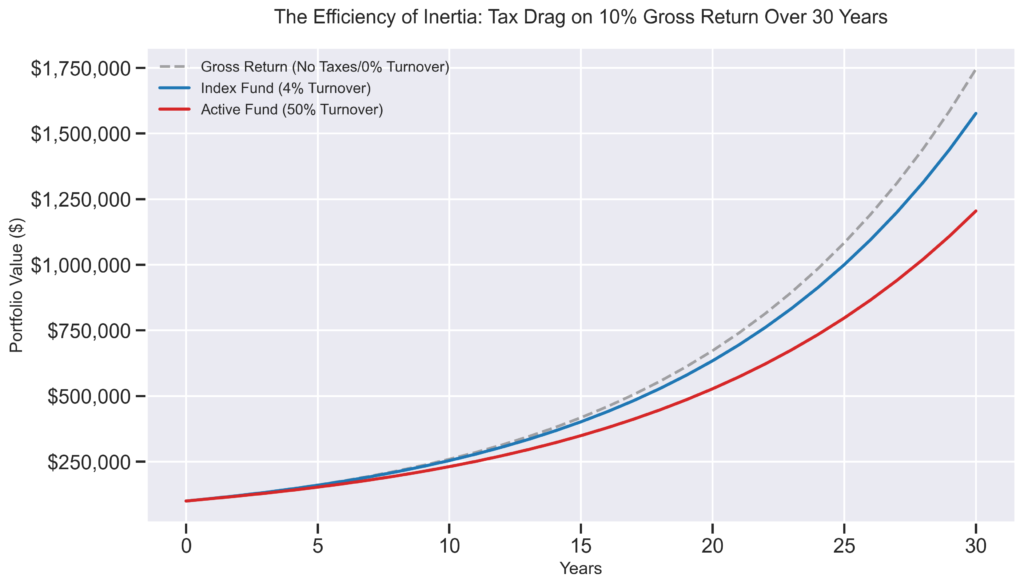
If we run a quick Python simulation to see how this plays out, it becomes pretty clear why high-turnover strategies have a built-in disadvantage. Imagine you start with $100,000 and manage to earn a 10% return every year, without ever having to sell anything or pay taxes along the way. After 30 years, you’d end up with about $1.74 million, which is basically the best-case scenario.
Now, if you look at an index fund that has to do a little bit of buying and selling each year—let’s say it turns over about 4% of its holdings annually—it still does really well. After 30 years, you’d have around $1.58 million, which means you only lost about 10% to taxes compared to the perfect, no-tax scenario. That’s actually a pretty efficient way to capture the growth of the market. The active fund with a 50% turnover rate finishes at $1,204,711.
That means the active investor gave up an extra $370,000 or so just because of taxes. Even though both investors earned the same 10% return before taxes, the active approach left them with almost a quarter less money at the end. To make up for this, an active manager would have to consistently beat the market by a pretty wide margin, year after year, for thirty years straight—which, as the data shows, almost nobody actually manages to do.
If you look at the chart from this simulation, you can actually see how the gap between these strategies starts out small but then really starts to widen over time. For the first ten years or so, the index fund’s growth line stays pretty close to the ideal, no-tax scenario. But by year fifteen, you notice the active fund’s curve starts to flatten, because the money that went to taxes early on isn’t there to keep growing. That missing compounding adds up fast, and by the end, the difference is huge.
Why inaction scales infinitely better
It’s natural for us to feel like doing something is always better than doing nothing, especially since, in the wild, staying put could mean missing out on food or getting caught by a predator, but when it comes to investing, making too many moves can quietly eat away at your returns through taxes.
Whenever you buy and sell investments, even just a little bit, you end up losing a small piece of your potential growth, and while financial advisors often talk about strategies like tax-loss harvesting or shifting your investments around to make it sound like they’re adding value, these moves can sometimes just cover up the fact that the real issue is the way the whole system is set up. If you simply hold onto an investment for the long haul without selling, it’s almost like the government is letting you use their money for free, since your gains can keep growing before you ever have to pay taxes on them.
So, if you’re looking for the single most powerful thing you can do with your taxable investments, it’s probably just to set things up so you don’t have to make changes very often; that means picking broad, low-cost index funds and then just letting them sit, since chasing extra returns is tough and unpredictable, but keeping your taxes low is something you can actually control.
References
[1] Morningstar Tax Cost Ratio Fundamentals. Morningstar Data. [2] ICI Fact Book, Mutual Fund Distribution and Turnover Trends.

Leave a Reply