You spend capital to generate a signal. Engineering rule: a signal nobody receives has zero value. The data proves luxury cars fail this test completely.
Disclaimer: The opinions expressed in this article are my own and do not represent the views of Google. This content is based solely on publicly available information.This content is for educational and entertainment purposes only. The author is not a financial advisor, and the content within does not constitute financial advice. All investment strategies and financial decisions involve risk. Readers should conduct their own research or consult a certified financial professional before making any financial decisions.
In signal processing, a transmission has exactly two parts: a sender and a receiver. The sender encodes a message, transmits it across a medium, and the receiver decodes it. If the receiver does not decode the message you intended — if the signal is intercepted, re-addressed, or ignored — the transmission has failed regardless of how much power you put into the broadcast.
This is the precise engineering definition of why a luxury car is a zero-ROI status signal.
Morgan Housel coined the underlying principle: when you see a Porsche on the highway, you do not think about the driver. You imagine yourself behind the wheel. The object is admired; the owner is invisible. The signal was transmitted with significant capital expenditure. It was received by the observer, decoded as a message about themselves, and the sender received no credit whatsoever. From a systems perspective, this is a complete transmission failure — and it happens every single time.
Housel puts it directly: “When you see someone driving a nice car, you rarely think, ‘Wow, the guy driving that car is cool.’ Instead, you think, ‘Wow, if I had that car people would think I’m cool.’”
The status signal is not low-return. It is literally zero-return. The ROI formula is:
ROI = (Perceived Social Gain) / (Capital Deployed)Since the social gain is intercepted and re-addressed to the observer rather than attributed to the sender, the numerator approaches zero. Divide zero by $55,000 and you get the exact return on your BMW purchase: nothing.
What the Swedish Lottery Study Actually Shows
The man in the car paradox explains why the signal fails socially. A separate body of research explains why it fails internally — why the luxury upgrade does not produce the emotional payoff the buyer expects.
Researchers tracking thousands of Swedish lottery winners found a precise distinction between two different measurements of wellbeing. The first was life satisfaction — asking winners to evaluate their lives on a scale. The second was day-to-day emotional state — measuring how much they actually smiled, laughed, or experienced stress in their daily lives.
Money improved the first metric significantly. Winners evaluated their lives more favorably. They looked at their accounts and concluded they were doing better. But money had statistically zero effect on the second metric. The lived experience — the moment-to-moment emotional state — was unchanged.
This is the engineering reality of hedonic adaptation. The status purchase patches the evaluation metric — the internal scoreboard that says “my life is better.” But it fails entirely to update the runtime experience — how you actually feel while living it. You updated your self-report. You did not update your experience.
The practical implication: you bought an upgrade to a variable that exists only during self-reflection. The other 23.5 hours of your day are running on the same runtime as before.
The Michigan Data: Zero Correlation
The hedonic adaptation finding from lottery studies is replicated in driving-specific research. University of Michigan researchers studied the relationship between a car’s market value and the driver’s actual enjoyment during a trip.
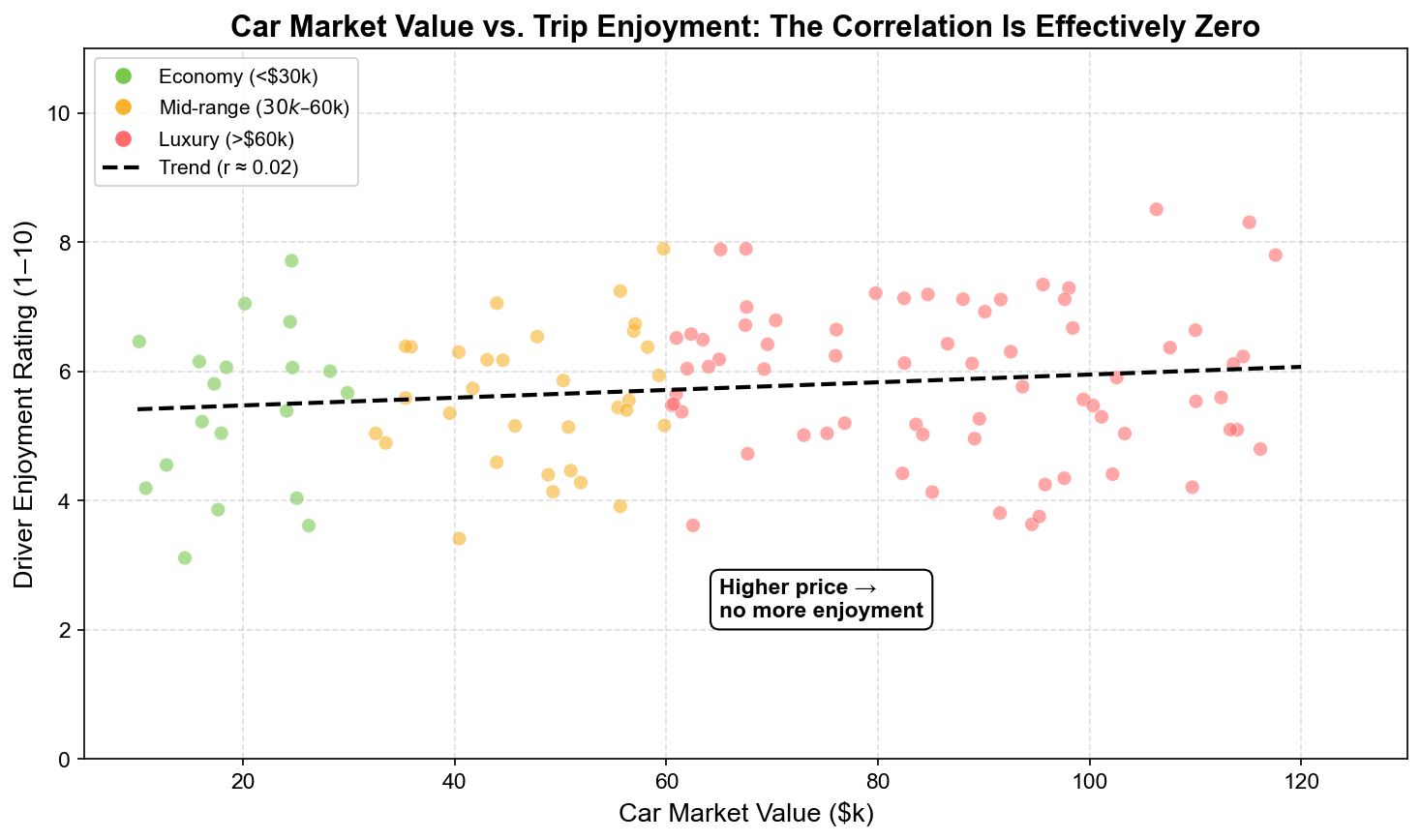
The finding was unambiguous: the correlation coefficient between car market value and in-trip enjoyment was effectively zero.
The chart below visualizes this relationship — high-value vehicles produce no measurable happiness premium over economy vehicles during actual use:
The explanation is what psychologists call the focusing illusion. When you are considering buying a luxury car, you focus entirely on the car — the interior, the badge, the performance specs. In that evaluation state, the car dominates your mental model and your predicted enjoyment is high.
But when you are actually driving the car, you are not thinking about the leather stitching or the M-badge on the steering wheel. You are thinking about traffic. You are thinking about the deadline you missed. You are listening to the same podcast you would have listened to in a Corolla. The car — $55,000 of capital deployed — has faded completely into the background.
The focusing illusion is a prediction failure mode. You are optimizing for a state of mind that only exists before the purchase, not during the years you are paying for it.
The Premium UI Element Nobody Uses
From a systems perspective, the luxury car is a premium UI element that the user ignores 99% of the time.
Think about what happens when you actually sit in the car. You adjust the mirrors — done once. You notice the stitched steering wheel — done in the first week. You feel the engine response pulling onto the freeway — appreciated for the first month, then background noise. The premium features that justified the $30,000 status markup are garbage-collected by your attention within weeks of purchase.
You allocated $30,000 in capital resources to a variable that gets garbage-collected the moment you turn the key. That capital, invested at 7% real return for 10 years, compounds to approximately $59,000. The car delivered nothing to your runtime experience. The opportunity cost delivered nothing to your net worth. The status signal was never received by its intended audience.
The ROI calculation is complete: the numerator is zero, the denominator is $55,000, and the opportunity cost is $59,000 in foregone compound growth.
The Compounding Cost You Are Not Seeing
The focusing illusion and zero status ROI are the psychological case against the premium vehicle. The financial case is simpler and harder to dismiss.
The BMW 3 Series carries a total cost of ownership — insurance, maintenance, depreciation, financing — of approximately $14,000 per year. The Toyota Corolla, which gets you to the same destination, sits at roughly $5,000 per year. The status premium is $9,000 annually.
Apply the Rule of 25 — William Bengen’s research establishing that a portfolio can sustain a 4% annual withdrawal rate indefinitely. Every dollar of permanent annual spending requires $25 in portfolio capital to sustain. The $9,000 annual status premium therefore requires an additional $225,000 in portfolio capital.
If you save $20,000 per year toward that $225,000 increment at 7% real return, the accumulation time is 8.6 years. The BMW badge just added 8.6 years of mandatory working life to your career.
But the full cost is worse than that, because the $9,000 annual premium is not just spent — it is not invested. At 7% real return over 20 years, $9,000 per year compounds to approximately $393,000. The Corolla driver who invests the status premium difference does not just reach financial independence 8.6 years earlier. They arrive with $393,000 more in portfolio capital than the BMW driver.
The signal was never received. The internal satisfaction lasted weeks. The financial cost will take two decades to fully compute.
Running the System Check
The man in the car paradox is not an argument against buying cars. It is an argument against buying cars to signal status — because the signal is never received, and the internal satisfaction is never sustained.
The practical system check before any status purchase is a two-part query:
Query 1: Who is the intended receiver of this signal, and will they attribute it to me or to themselves?
If you are honest about the answer, most status purchases fail here immediately. The observer imagines themselves in possession of the object. The sender receives no credit.
Query 2: How long will the runtime experience differ from my current experience?
If you have bought similar upgrades before, you already have calibration data. The focusing illusion fades within weeks. The new baseline becomes the current normal. The delta disappears.
If both queries return negative signals, the capital is better deployed in your investment account where it generates compounding returns in silence — not in a UI element that gets garbage-collected after the novelty period.
What This Changes in Practice
The man in the car paradox does not require extreme frugality. It requires accurate accounting.
A reliable, safe vehicle that gets you where you are going is genuine utility — it has a real ROI because it solves a real problem. The Corolla delivers that utility at $25,000. The BMW 3 Series delivers the same functional utility at $55,000. The $30,000 delta purchases no additional utility, generates no status signal that lands, and produces no runtime happiness premium. It purchases the evaluation-layer update — the ability to answer “what do you drive?” with a different noun.
The question is whether that noun update is worth $30,000 in capital and $59,000 in foregone compounding over 10 years.
For most engineers who run this calculation honestly, it is not. The freedom cost of the status signal — measured in years of mandatory work added to your career — tends to reframe the decision entirely. The BMW 3 Series costs not $55,000 at the dealership. It costs 8.6 years of your working life. The Porsche 911 costs 13.4 years.
Those are the numbers when the status signal fails to land. And based on the data, it always fails to land.
This article draws from Chapter 2 of The Wealth Kernel, which builds the full framework for identifying and auditing status-driven financial decisions. The Freedom Cost Matrix in Chapter 2 translates every vehicle choice into years of mandatory working life — making the opportunity cost of status spending impossible to ignore.

Leave a Reply